By Marijn van Essen on Sep 28, 2026, 2:00:03 PM
%20Blog%20EN.png?width=1920&height=1080&name=Whitepaper%20(A)%20Blog%20EN.png)
Why your Project Controls software is live but impact is missing?
Your Project Controls software is live. Schedules are being updated. Risks are registered. Dashboards are available and progress reports are produced on schedule.
Yet before the next progress meeting, the planner is still checking which schedule version is current. The cost controller is reconciling the latest forecast with progress data. Project managers are pulling information from spreadsheets to understand whether important milestones are still achievable.
By the time everyone agrees on the current position, much of the meeting has already been spent discussing the data rather than deciding what to do about it.
Meanwhile, schedule risks become visible once float is already disappearing. Milestones begin to move. Forecasts deteriorate. Issues that should have triggered action earlier are now being escalated.
The software is working. So why does the organisation still feel reactive?
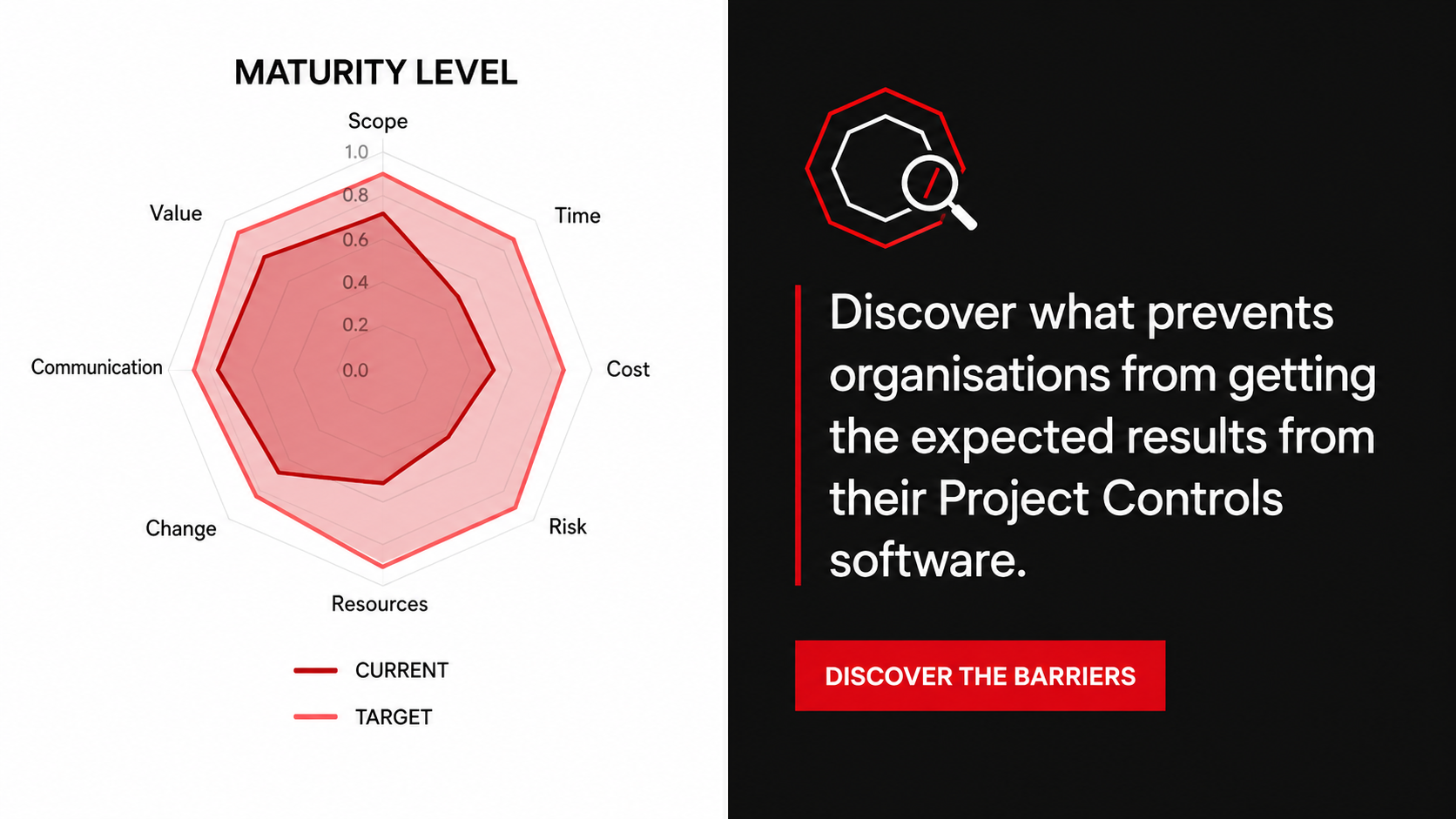
That gap between having Project Controls software and actually gaining more control is more common than it may seem. And it rarely starts with a missing software feature.
Go-live is not the same as having control
The expectations behind a Project Controls software investment are usually clear.
Better visibility. More consistent reporting. Earlier warnings. Better coordination between planning, risk and cost. Ultimately, greater confidence in where projects are heading and enough time to intervene when something starts to move off plan.
A successful technical implementation creates the conditions for this. It does not automatically create the behaviour around it.
The system can be configured correctly. Users can be trained. Data can be entered and dashboards can be generated. But if projects are still governed, reported and discussed in largely the same way as before, the organisation may simply have transferred its old way of working into a more sophisticated platform.
The real gap is between information and action
Project Controls software can tell you a great deal about a project. It can support schedules, risks, costs, resources, changes and reporting.
But the software cannot decide how your organisation should respond when something changes.
Imagine a dashboard shows that an important milestone is moving. What happens next?
Does someone understand what is driving the movement? Is the potential effect on cost or risk understood? Is somebody responsible for investigating it? Is there an agreed point at which the issue should be escalated? And does the team have enough confidence in the information to act?
If these questions are difficult to answer, the problem is no longer simply whether the software works.
It is about how processes, responsibilities, information and decision-making work around it.
That distinction matters because Project Controls is not simply a collection of systems and reports. It is the way an organisation uses information to understand project performance, identify deviations and make decisions early enough to influence the outcome.
When Project Controls is live but still reactive
The signs that Project Controls has not yet become part of the organisation's way of steering are often visible in everyday project work.
You do not need to see every possible problem at once. A few recurring signals can already indicate that the issue goes beyond software configuration.
Information is available, but decisions still come late
Schedules are updated, risks are registered and dashboards are produced. Yet teams still spend significant time establishing what the information actually means before they can decide what to do.
A warning may already be visible in the data, but if ownership, thresholds or follow-up actions are unclear, that warning does not automatically lead to intervention.
The organisation is reporting performance, but it is not necessarily steering on it.
Teams still create their own version of the truth
When pressure increases, familiar workarounds often return.
A planner maintains an additional spreadsheet. A project manager builds their own overview. Different projects use slightly different structures, definitions or reporting cycles.
Each workaround may solve an immediate problem, but together they make it harder to compare projects, trust consolidated information and understand performance across a portfolio.
Planning, risk and cost do not tell the same story
Planning, risk, cost, resources and change may all be managed professionally within their own disciplines. The problem arises when those disciplines are not sufficiently connected.
A schedule may show pressure on a milestone while the related risk is managed elsewhere. A changing forecast may be discussed without a clear connection to progress or schedule performance.
Each team sees part of the project. The organisation still has to bring those perspectives together before it can understand the full impact.
These situations do not necessarily mean that the software is failing. They suggest that the next challenge lies in how Project Controls is embedded around it.
The next question is not which feature you are missing
When organisations recognise these symptoms, the natural response is often to return to the technology.
Do we need another dashboard? More training? Another integration? Should we use more of the available functionality?
Those may be useful actions, but they should follow a more fundamental discussion.
Start by asking:
- What do we actually need to steer on? Which developments should become visible early enough to influence the outcome?
- Which information needs to come together? Are planning, risk, cost, progress and change providing a coherent view of performance?
- What happens when something moves outside expectations? Is ownership clear, and does the information lead to a decision or action?
These questions move the conversation away from software usage alone and towards the way Project Controls operates across the organisation.
That is also where the difference between a technically successful implementation and sustainable Project Controls becomes clearer.
Software should support Project Controls, not define it
Going live remains an important milestone. But it is not the point at which the work ends.
The real value of Project Controls software appears when people can trust the information in front of them, understand what it means and respond before a deviation becomes an escalation.
That requires technology, but it also requires alignment around the technology.
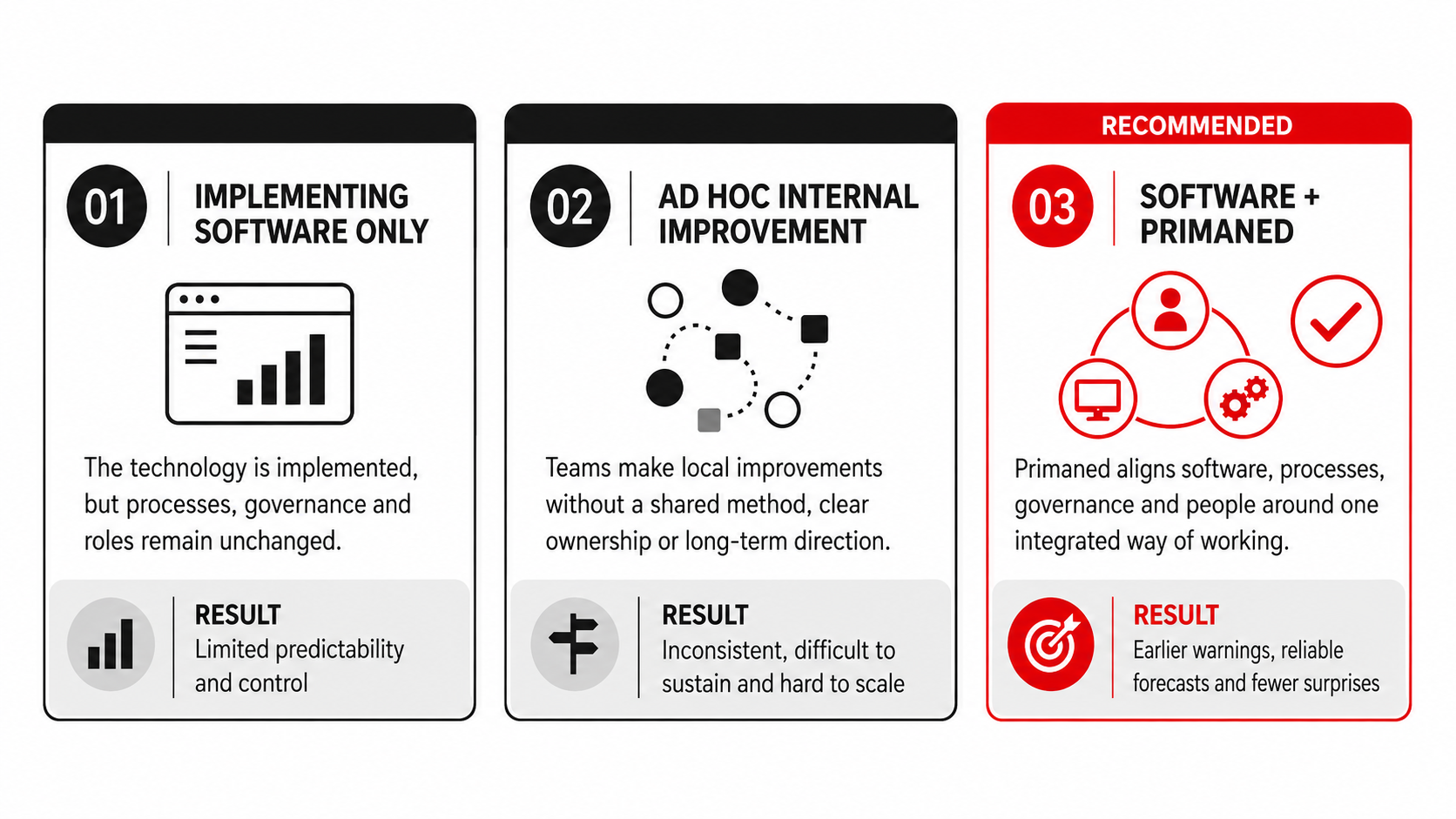
When that alignment is missing, organisations can spend considerable time improving individual reports, configurations or processes without addressing the underlying reason why Project Controls remains reactive.
And that leaves an important question:
If the software itself is not the problem, where should you focus next?
You have the software. So where should you focus next?
Recognising the problem is one thing. Understanding where it originates in your organisation, which route to take and what to improve first is the more difficult part.
That is where our whitepaper, You Have the Software, but Not the Results, continues.
It explores the recurring organisational reasons why Project Controls stalls after implementation, the different ways organisations respond when expected results are missing, and a practical route towards more mature and proactive Project Controls.
If your software is live but teams are still reconciling information, creating workarounds or reacting later than they should, this is the next step.