
By Mehdi Ababa on Jan 22, 2026, 11:35:08 AM
In many organisations, the terms document management and document control are used interchangeably. On the surface they appear similar, yet they represent two very different disciplines that each determine how well a project can rely on its information. This subtle distinction has major consequences for quality, traceability and compliance, particularly in complex and multi-disciplinary projects.
The challenge is that many teams believe they have information under control simply because documents are stored and shared. In practice, this often results in uncontrolled distribution, parallel versions and unclear approval routes. These issues can escalate quickly, affecting not only day-to-day collaboration but also project timelines, contract negotiations, audit readiness and safety management.
Document management focuses on storing and sharing information, while document control focuses on governing, validating and securing it. When these disciplines are treated as the same, organisations lose oversight and introduce unnecessary risk. When they are distinguished properly, they create a foundation for predictable delivery, proactive risk mitigation and confident decision-making.
For document controllers and PMO leaders, understanding this difference is not just operational. It is a critical factor that influences the entire project lifecycle and shapes the organisation’s ability to maintain control in high-pressure environments.
Document Management – The Foundation of Information Handling
Document management forms the backbone of any modern organisation. It focuses on organising, storing, retrieving, and sharing documents efficiently. At this level, the goal is accessibility and collaboration, ensuring that everyone can find and use the right information at the right time.
Platforms such as SharePoint, Google Drive, or basic project portals support document management by making information easily available. Common features include:
- Centralised cloud storage
- Basic version tracking
- Access permissions
- Easy file sharing across teams
Document management is therefore essential for productivity and teamwork, but it has its limits. Without additional control mechanisms, there’s no guarantee that the documents being shared are the approved and up-to-date versions.
If you are wondering whether project controls software is a “nice-to-have” or an essential investment, this blog explores why it has become a must-have for modern project organisations.
.png?width=1200&height=800&name=10.%20Marketing%20Q324%20-%20Software%20Buyer%20Journey%20Assets%20-%20Graphics%20(3).png)
Document Control – Accuracy, Compliance, and Governance
Document control goes a significant step further. Where document management focuses on access and organisation, document control ensures integrity, compliance, and governance.
Here, every document follows a structured process for review, approval, and release. Document control is not simply about managing files. It is about managing the entire lifecycle of information.
Typical document control capabilities include:
- Version and revision tracking for full traceability
- Approval workflows to validate documents before release
- Audit trails showing who did what, and when
- Strict access control to maintain data integrity
In sectors such as construction, engineering and infrastructure, document control is essential. Errors caused by outdated or unapproved information can lead to delays, disputes or safety risks. Document control ensures that only accurate, approved and compliant documents circulate within the project.
Attempting a rollout or migration without expert guidance often leads to setbacks. The following blog ''Why Migrating from One Project Controls Tool to Another Is Rarely Just a Technical Switch'', will help you understand what’s really involved in a successful migration. Spoiler alert: it's not just about data exports and imports.

The Pyramid of Information Management Maturity
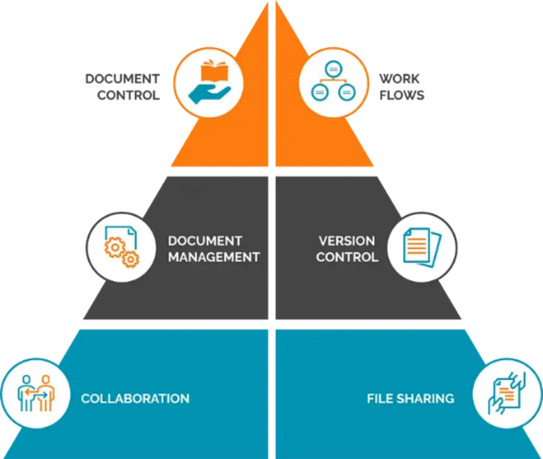
A useful way to visualise the relationship between document management and document control is through the Pyramid of Information Management Maturity. This model illustrates how organisations evolve in their ability to manage and govern information effectively.
Source: [cognidox.com]
- At the base of the pyramid, we find file sharing and collaboration. These are the foundations of information handling, enabling teamwork, but with minimal control or formal processes.
- The middle layer includes document management and version control. Here, structure begins to take shape. Documents are easier to organise and track, but governance is still limited.
- At the top of the pyramid sit document control and workflows. This is where organisations achieve true information governance, quality management, and lifecycle control. Every document follows a defined process, ensuring accuracy, accountability, and compliance.
The higher you move up the pyramid, the stronger your ability to manage, control, and trust your information.
Curious to read about how Dura Vermeer has transformed its way of working with Oracle Primavera Cloud? Explore their full story here.
Why Document Control Matters
Many organisations operate somewhere in the middle of the pyramid. They have systems in place for document management, but lack formalised control processes.
The consequences can be costly:
- Confusion about which version is the latest or approved
- Project delays caused by incomplete review cycles
- Legal or compliance risks during audits or disputes
Document control eliminates these issues by creating clarity and consistency. Every document moves through a predefined workflow, resulting in a single, verified source of truth. And with full audit trails, every action is traceable, from upload to approval.
How Oracle Aconex Elevates Document Control
Oracle Aconex is not a traditional document management system. It’s a collaboration platform built for complex projects, where effective teamwork depends on reliable, controlled information.
Within this collaborative environment, Aconex integrates powerful document control capabilities that ensure all project data is accurate, secure, and compliant.
With Aconex, organisations can:
- Automate approval workflows
- Maintain complete version history and audit trails
- Set granular access rights for teams and disciplines
- Ensure compliance through standardised processes
By combining collaboration with structure, Aconex helps teams move beyond simple file sharing or document management. It supports organisations in reaching the top of the information maturity pyramid, where information is governed, validated and trusted.
From Sharing to Mastering
Document management and document control are not competitors; they are stages in the same journey toward information maturity. You cannot control what you have not first managed, but management alone is not enough for projects that demand precision, compliance and accountability.
‘Document management makes information accessible. Document control makes information reliable.’
Organisations that reach the top of the maturity pyramid no longer simply store or distribute documents. They master their information and strengthen quality, compliance and efficiency across each stage of the project.
Curious to see what structured document control could mean for your organisation?
Get in touch with one of our specialists or explore how we have helped other teams gain more control, quality and confidence in their document processes with Oracle Aconex. Together, we make reliable project information the standard.

%20Blog.png)
When Does Your Project Need Oracle Aconex? 7 Questions to Ask
Your project may already rely on Microsoft SharePoint, Microsoft Teams and an established document-management process. Yet drawings, the discussions around them …

Microsoft Project Online Is Retiring: What It Means for Your Organisation and the Road Ahead
On September 30, 2026, Microsoft Project Online will officially retire (source: Microsoft Announcement). Unlike earlier announcements suggesting the product wou …
Avoiding Failure in Project Controls Software Implementation with the Right Partner
When organisations invest in new project controls software, they often believe the hardest part is choosing the right tool. The reality is very different: the t …