
By Mark Roodbol on Oct 23, 2026, 10:00:01 AM
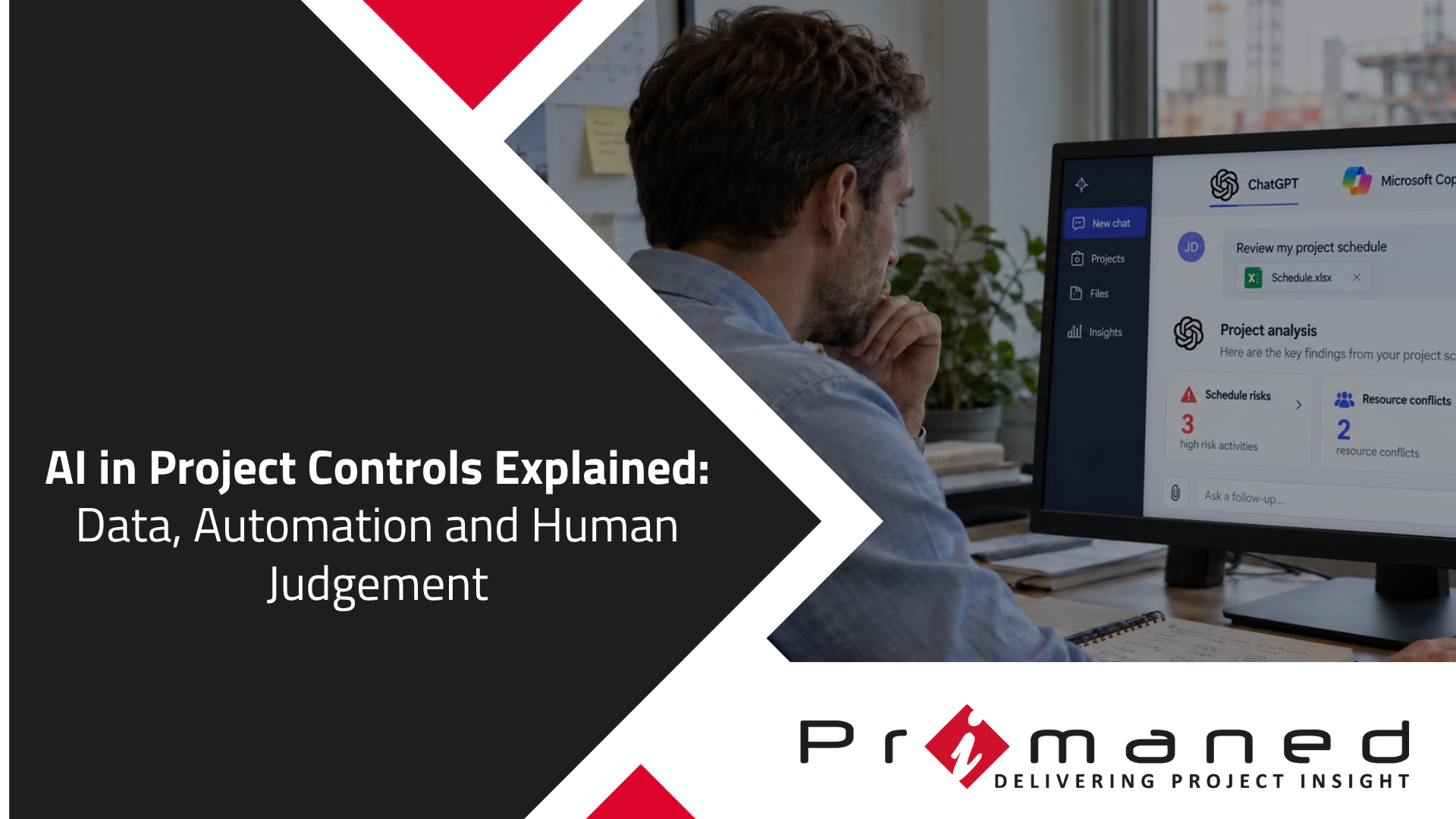
Project Controls depend on information. Schedules, progress updates, contracts, emails, meeting notes, risk information and management reports all help teams understand where a project stands and where action is required.
The challenge is that much of this information still takes considerable effort to collect, structure and interpret. A planner may spend hours processing progress updates before there is time to investigate what those updates actually mean for the project.
Artificial intelligence can begin to change that balance.
AI has become considerably better at working with language, while more project information is being stored digitally and brought together across cloud-based systems. For Project Controls, that creates new possibilities: processing information faster, finding exceptions in larger volumes of data and automating parts of repetitive workflows.
But AI is not one technology, and not every application requires the same foundations.
Understanding those differences is important if project organisations want to move beyond experimentation and identify where AI can create practical value.
Why AI is becoming more relevant to Project Controls
Project Controls contains far more language than we sometimes recognise.
Contracts, progress reports, correspondence, meeting notes, explanations of delay and management narratives all contain information that influences project decisions. Historically, much of this information was difficult for software to interpret because it was largely unstructured.
Modern language models have changed that.
They can process, classify, compare, and summarise text at a scale that would be difficult to achieve manually. A two-hour progress meeting can, for example, be turned into a proposed list of decisions and actions. A collection of progress reports can be screened to identify the few that contain unusual developments requiring closer attention.
That does not mean the AI has suddenly understood the entire project. It means professionals can spend less time finding relevant information and more time assessing its significance.
This development sits within a broader change across construction and engineering technology. In our earlier article on how AI, IoT and cloud technologies are transforming construction, we explored how increasingly connected project environments are creating new opportunities to use information more intelligently.
For Project Controls professionals, the question now becomes more specific: which forms of AI can support which parts of our work?
AI is not one thing
It is useful to distinguish between three broad types of AI applications in Project Controls.
They overlap, and the technology will continue to develop, but the distinction helps organisations understand the different opportunities and requirements.
1. Language-based AI
Language models are designed to work with written or spoken information.
Within Project Controls, this can include:
- summarising progress meetings;
- extracting proposed actions, responsibilities and dates;
- comparing multiple reports;
- highlighting exceptions in project narratives;
- classifying incoming information;
- preparing a first draft of a management update.
- timely project information;
- sufficient quality for the intended application;
- consistent definitions;
- clear data ownership;
- appropriate structure;
- relevant context;
- agreed controls and responsibilities.
These applications can be relatively accessible because they do not always require years of historical data.
If the task is to summarise today's progress meeting, today's transcript may be sufficient. If you want to compare this week's forty progress reports and identify which ones contain unusual issues, those reports themselves may provide much of the information required.
That makes language-based AI a useful example of why the statement “we do not have enough data for AI” can be misleading.
The real question is: enough data for what?
2. Predictive AI
Predictive models answer a different set of questions.
Instead of primarily interpreting language, they analyse patterns in historical information to estimate what may happen next.
Imagine an organisation with consistent data from many completed and ongoing projects. It could analyse how often particular activity types have overrun, which combinations of conditions tend to precede delay or where recurring risk patterns appear.
That has clear relevance for Project Controls because it can help shift attention from explaining problems after they occur towards identifying signals earlier.
But predictive applications require a stronger data foundation.
Comparisons between projects only become meaningful when the underlying information is sufficiently consistent. Activity structures, definitions, progress methods, coding and historical records all influence the quality of the analysis.
This connects closely with the broader role of analytics in Project Controls. From Gut Feel to Foresight: The Crucial Role of BI & Data Analytics in Project Controls explores why integrated information, shared definitions and leading indicators matter when organisations want to move from retrospective reporting towards earlier decision support.
3. AI-supported automation
The third area goes beyond analysing or generating information.
AI-supported automation can perform several connected steps within a workflow.
Think about a recurring process in which a professional gathers information, structures it, performs checks, enters the result into another system and prepares an output for management.
Instead of supporting only one step, an automated workflow could increasingly connect several of them.
For example, progress information could be collected and structured automatically before a planner reviews the proposed changes. The professional still validates the result and provides the context but no longer has to perform every administrative step manually.
This is where substantial efficiency gains could emerge.
It is also where control becomes more important.
The more a system is allowed to act, the more clearly an organisation needs to define what it may do, which information it may use, where approval is required, and who remains responsible.
Automation can reduce repetitive work. It does not automate accountability.
Different AI applications require different data
Data quality is fundamental to AI, but the requirements depend on the use case.
A language model analysing one document does not need the same information environment as a predictive model comparing performance across hundreds of projects.
That distinction matters when assessing AI readiness.
For language-based applications, the organisation may already have enough information to begin experimenting with a contained use case.
Predictive analytics may require much more work first: consistent historical information, suitable structures, comparable definitions, and sufficient data quality.
The sequence should therefore be:
problem → use case → information requirements → technology
rather than:
technology → find somewhere to use it
That approach also prevents organisations from building unnecessarily large AI or data programmes before they know which project decision they are trying to improve.
AI only knows the project through the information it receives
No matter how capable an AI system becomes, it does not experience your project in the same way a professional does.
It has not visited the site.
It does not know the contractor because it has worked with them for two years.
It did not hear the hesitation in a stakeholder's answer during yesterday's progress meeting.
It does not automatically know that a technically possible planning change is commercially unacceptable.
It knows the project through the information made available to it.
That makes the quality and timeliness of project information essential.
If recorded progress is three weeks behind reality, the AI is effectively analysing the project as it existed three weeks ago. A more advanced algorithm does not solve that problem.
Good AI therefore reinforces the need for good Project Controls discipline rather than replacing it.
Data quality is also about shared meaning
Reliable information is not simply information stored in the right system.
People also need to agree on what that information means.
Take the word delay.
Ask several people in the same organisation how delay should be measured and you may receive different answers. One person may compare against the contractual baseline. Another may compare against the previous reporting period. Someone else may only consider a delay relevant when it affects a milestone.
Humans can sometimes navigate this ambiguity through conversation and experience.
Automated analysis needs clearer definitions.
The same applies to ownership. When an important dataset contains errors or contradictory information, somebody needs to be responsible for resolving them.
A useful AI foundation therefore includes:
These are broader Project Controls maturity questions, not purely AI questions.
If inconsistent processes, fragmented information or unclear governance are already limiting project performance, introducing AI will not automatically remove those weaknesses. Gaining Control Starts with Clarity: Why Maturity in Project Controls Matters examines why alignment between processes, people, information and tooling should come before selecting the next technological solution.
Why human judgement becomes more important
A common question is whether AI will eventually replace planners, schedulers and other Project Controls professionals.
That question underestimates what those professionals actually contribute.
AI can process the information it receives. A planner works within the social reality of the project.
They speak to contractors, engineers and project managers. They participate in progress meetings. They understand the reasoning behind previous decisions. They recognise when something that looks possible in a schedule will not work on site.
Projects are not simply datasets. They are environments in which technical, commercial and human factors continuously interact.
That is why the human in the loop is more than somebody clicking an approval button at the end of an automated process.
From producing information to exercising judgement
The result is not that Project Controls expertise becomes less important.
Its emphasis changes.
Some activities that consume significant time today are well suited to AI support: reading large volumes of text, structuring information, preparing initial reports, or performing repetitive checks.
Reducing that administrative workload creates room for higher-value activities.
A planner can spend more time discussing progress with the people delivering the work.
A Project Controls manager can spend more time investigating exceptions and testing possible interventions.
Professionals can spend more time interpreting information, challenging proposed scenarios, and advising decision-makers.
This shift can be summarised particularly well during our internal discussions: AI does not remove Project Controls craftsmanship. It increases the importance of professional judgement because more time and responsibility can move towards the decisions around the information.
The direction is therefore not from human to AI.
It is from manual processing towards human judgement supported by AI.
Where should an organisation start?
The first AI application does not need to be ambitious.
A better starting point is a small, recurring activity that takes significant time but requires relatively limited complex judgement.
That combination gives the organisation a clear opportunity to learn.
Consider a recurring progress process. A planner may spend considerable time collecting information, structuring updates and preparing them for further analysis.
Parts of that workflow could potentially be supported by AI while the planner continues to gather context from the project team, verify the resulting information and decide whether proposed changes make sense.
The objective is not to remove the planner.
It is to make better use of scarce professional expertise.
A practical first approach is:
- Identify one recurring problem. Where is substantial time being spent without equivalent decision value?
- Define the required outcome. What should improve: speed, consistency, insight or something else?
- Understand the information requirement. What documents, data or context does the application need?
- Assign ownership and controls. Who validates the result and who remains responsible?
- Test at a manageable scale. Select an application where professionals can quickly assess the quality of the output.
- Learn before expanding. Improve the process and only scale when the application is delivering reliable value.
This also means an organisation may discover that AI is not its first priority.
Better definitions, data integration, governance or standardised processes may need to come first.
That is a useful outcome too.
For organisations that want to understand those wider foundations, Primaned's Project Controls Scan looks at the maturity of areas including planning, cost control, risk, governance, reporting and tooling before defining improvement priorities.
Think Big, begin small. But begin now.
Do not start by asking where your organisation can “implement AI”.
Start with a Project Controls problem.
Find one recurring activity where faster processing or better analysis could create meaningful value. Understand what information it depends on. Define the boundaries. Keep professional review in the process. Then test whether AI genuinely improves the way the work is done.
You do not need to solve the future of AI in Project Controls before taking the first step.
You need one relevant problem, one controlled application and enough discipline to learn from it.
If you want to explore where that first step could sit within your existing Project Controls environment, Primaned's Project Controls consultants can help connect the technology to the processes, information and decisions behind your projects.